



An emergency can strike when we least expect it. A wildfire that leads to an evacuation, a flood, an earthquake, a gas leak, or a fire in the building itself can make it necessary to leave our home at a moment’s notice.
In a situation like this, we’ll probably understand that we need to get out as soon as possible. But if we live with cats or dogs, we’re faced with an important question: Would we know how to evacuate them quickly and safely?
Finding a terrified cat that has hidden away, realizing that the carrier is stored in a hard-to-reach place, trying to handle several animals at once, or leaving home without essential medication can complicate an evacuation—precisely when every minute counts.
That’s why protecting them during an emergency begins well before it happens. Having an evacuation plan, getting everything ready, and knowing who will be responsible for what within the family can make a big difference.
In this guide, we’ll explain what you should plan for so that you can act more quickly and safely if you ever need to evacuate your home with your cats or dogs.
Why Should You Include Your Pets in Your Evacuation Plan?
When an emergency strikes, circumstances can change very quickly. A situation that initially only requires us to “stay alert” can end up resulting in an official evacuation order, leaving us very little time to get organized.
That’s why pets should be part of the family plan from the very start.
We should not assume that we can leave first and then come back later to pick them up. Depending on the type and severity of the emergency, authorities could restrict access to the evacuated area, and we might not be able to return for hours or even days.
Planning ahead helps reduce the need for last-minute decisions in high-pressure situations and allows you to catch problems that might otherwise go unnoticed until you absolutely need to deal with them.
Safe Transportation for Each Animal
One of the issues we need to figure out beforehand is how we’re going to physically get each individual cat or dog out of the house.
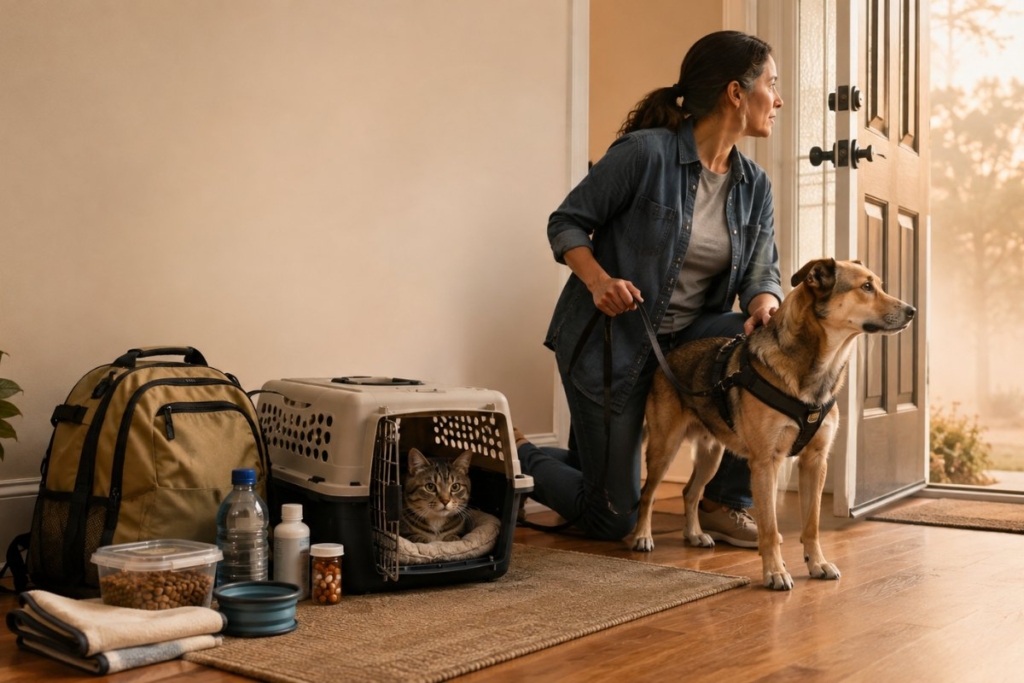
When it comes to cats, it’s best to have a safe and appropriate carrier for each one. International Cat Care recommends that each cat has its own carrier and that you work with them beforehand to make them as familiar with it as possible.
In addition, it must be easily available. Storing it disassembled in a storage room, attic, or hard-to-reach place can cause us to waste valuable time.
Incorporating the carrier into your cat’s usual environment, placing a familiar blanket inside, or using treats can help create positive associations and prevent the carrier from being seen as something that only appears when something bad happens. If you’d like to work on this process in more detail, our article on how to help your cat stay calm during a trip to the vet offers practical tips for getting them used to the carrier and reducing the stress associated with the trip.
When it comes to dogs, we should make sure we have a harness or collar and a leash on hand—and in good condition—to use when taking them out.
Handling and transporting a frightened cat or dog requires certain considerations, which we will discuss in this guide on how to safely evacuate cats and dogs during an emergency.
How to Organize the Evacuation
Once you’ve made the necessary arrangements to transport them, it’s a good idea to check whether you could actually evacuate all the dogs and cats you live with if you had to leave your home on short notice.
Taking the time to practice this drill allows you to identify any difficulties and get organized before you find yourself in a real emergency situation.
Make sure you can evacuate them all safely
If you live with several cats or dogs, having enough carriers, leashes, or harnesses doesn’t necessarily mean you can handle them all at the same time.
Try this simple test: Can you safely get all the dogs and cats out of the house using the resources and help that’s currently on hand?
Keep in mind not only the number of pets, but also their size, their mobility needs, and how many people would be needed to transport them safely.
If the answer is no, the plan should include additional support or a change in plans. Spotting this early on will allow you to find a solution before you actually need it.
Decide who’s taking care of which pet
If there are several people living in the house, it’s a good idea to establish in advance who will be responsible for each task:
- Who will be responsible for each cat or dog?
- Who will get the carriers?
- Who will grab the emergency kit?
- Who will make sure everyone has gotten out?
- Who will take care of other family needs during the evacuation?
It may be helpful to delegate specific duties:
Cat 1 → carrier 1 → Person A.
Cat 2 → carrier 2 → Person B.
Dog → harness and leash → Person A.
The aim is not to create a complicated protocol. The goal is that, if the time comes, everyone will know what to do and all dogs and cats can be safely evacuated.
Know Your Cat’s Usual Hiding Places
Fear can significantly alter a cat’s behavior. When faced with loud noises, people rushing around, or other stimuli it sees as threatening, it may seek refuge in the very places in the home that are hardest to reach.
Find out in advance where they usually hide: under a bed, inside a closet, behind a sofa, or in any other space they use when they need to feel safe. Anyone who might have to evacuate them if you aren’t there should also know this information.
If there is a real and imminent threat but an official evacuation order has not yet been issued, it may be wise to take preemptive action to prevent the animal from getting into hiding places where it would be difficult to get them out quickly. Always strive to maintain a calm environment, without chasing the animal or forcing unnecessary interactions.

Prepare an Emergency Kit for Your Cats and Dogs
In addition to an evacuation plan, it’s recommended to have a kit ready with the basic supplies you might need during the first few hours or days away from home.
In general, it should include:
- Food and water.
- Regular medication.
- Medical records and health information.
- Basic hygiene and first-aid supplies.
- Items needed for their transportation and care.
The important thing at this stage is that the kit is ready, up to date, easy to carry, and stored in an easy-to-reach place.
We’ll cover how much to keep on hand, what documentation to include, how to organize medications, and what specific items cats and dogs need in our guide on what an emergency kit for cats and dogs should contain.
Make Sure Their Microchip is Up-to-Date
During an emergency, the risk of being separated or getting lost goes up. Therefore, proper identification is a crucial part of the plan.
The microchip makes it possible to link a cat or dog to its owner’s registered information. But having a microchip loses much of its usefulness if the phone number or other contact information is out of date.
Periodically check to make sure your registered information is correct, especially after changing your address or phone number.
It’s also a good idea to keep recent photos of each pet, as well as one where you appear together. These can be helpful in identifying them if you get separated.
In addition to any physical copies you deem necessary, save your documentation and important information digitally so you can access it even if you don’t have the documents with you.
Prepare an Emergency Information Card Tailored to the Needs of Each Cat or Dog
During an evacuation, someone else may have to take care of your pet, transport them, or explain their needs to a veterinarian. That’s why it’s a good idea to prepare an individual emergency card with essential information about each pet.
It’s good to include:
- Name and recent photo.
- Microchip number.
- Age.
- Relevant illnesses or medical conditions.
- Medication, dosage, and frequency.
- Storage conditions for medications.
- Special diet, if applicable.
- Known allergies.
- Mobility needs.
- Important information about the pet’s behavior or handling.
- Guardian’s phone number.
- Alternative contact.
- Information about the pet’s regular veterinary clinic.
It’s not necessary to include their entire medical history. The purpose is to allow someone else to quickly find the information they need in order to care for them properly.
In addition, if your cat or dog has a chronic illness, a disability, mobility issues, is elderly, or has special care needs, the plan should also address how you will be able to physically transport them if they cannot walk or need additional assistance.
If any medication requires refrigeration or depends on a specific device or material, also plan how to store and transport it during the evacuation.

Decide Where to Go
Leaving the danger zone is only part of the evacuation. Afterwards, you’ll need a place to stay with your pets.
Not necessarily all accommodations or designated shelters allow pets, so it’s a good idea to research your options before you need them.
You can consider different alternatives:
- Family members or friends who can take you in.
- Pet-friendly accommodations.
- Residences or shelters.
- Resources that government agencies may make available during an emergency.
Don’t rely on just one option. The emergency itself could prevent you from reaching your originally planned destination.
If your pet has a chronic condition or needs ongoing veterinary care, it may also be helpful to know where the veterinary clinics are located in the area you’re likely to be traveling to.
Who Will Evacuate Them if You’re Not Home?
An emergency doesn’t necessarily have to happen when the whole family is together. You might be at work, running an errand, or simply away from home when an evacuation order is issued.
That’s why a key part of the plan is to have a trusted person who can access your home and evacuate your pets if you’re unable to do so.
That person should:
- Be able to get into your home.
- Know your cats and dogs.
- Know how many pets live in your home.
- Know their usual hiding spots.
- Know where the carriers, leashes, and harnesses are.
- Know where the emergency kit is.
- Be aware of any important medical needs.
- Have your contact information on hand.
Whenever possible, also designate a second trusted person in case the first one is unavailable.
Plan Several Evacuation Routes
An evacuation plan should not depend on a single route. Depending on the type of emergency, certain streets, roads, elevators, building entrances, or areas of the town may become inaccessible or be restricted by emergency services.
Be familiar with the different exits from your home and, whenever possible, consider alternative routes for leaving the area. If you rely on a car, also think about what you would do if you couldn’t use it or access it.
The priority will always be to follow the instructions of the emergency services and the authorities responsible for the evacuation.
Rehearse Beforehand
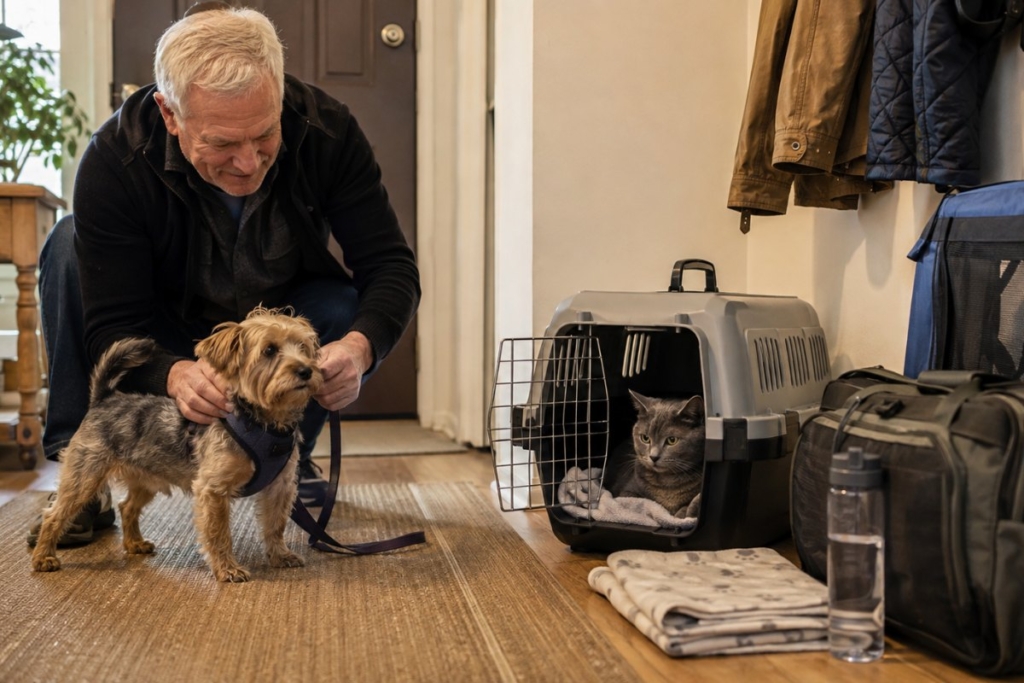
A plan that has never been tested may hide problems we hadn’t anticipated. There’s no need to simulate an emergency, set off alarms, or create stress. It’s simply a matter of calmly verifying whether the organization works.
You can practice:
- Locating each cat or dog.
- Having the carriers ready.
- Putting on leashes and harnesses.
- Making sure you can handle them all safely.
- Picking up the emergency kit.
- Reviewing the tasks assigned to each person.
- Checking how long it takes you to get ready to leave.
Organizations such as the Centers for Disease Control and Prevention (CDC) include this practice in their emergency preparedness recommendations.
If you encounter any difficulties during the trial run, you’ll have identified a problem that you still have time to fix.
Regularly Review Your Evacuation Plan
Creating a plan once and then forgetting about it for years can render some of the information or materials useless.
Review it frequently and whenever there are significant changes:
- Check the information associated with the microchip.
- Review medications and their storage requirements.
- Replace any expired items in the kit.
- Check carriers, leashes, and harnesses.
- Update photos and emergency contact forms.
- Review the contact information for people who could help you.
- Adjust the plan if a new cat or dog joins your family.
- Update it if your pet’s medical, mobility, or behavioral needs change.
- Review your planned accommodation options.
The plan should change as your family’s needs change.
FAQs About Evacuation Plans for Cats and Dogs
Should I have a separate carrier for each cat?
Yes. It’s recommended to have a safe and appropriate carrier for each cat and keep it in a place that’s easy to reach. It’s also a good idea to get your cat used to the carrier beforehand so that it becomes part of their environment and isn’t something that only shows up when they need to leave the house.
What should I do if I have multiple animals that I can’t evacuate on my own?
Your plan should consider this situation before an actual emergency happens. Decide who will be responsible for each cat or dog, and, if necessary, enlist the help of family members, neighbors, or other trusted people who can lend a hand. Conducting a trial run beforehand will allow you to verify whether the plan is truly feasible.
What happens if I’m not home when the emergency happens?
It’s a good idea to have at least one trusted person who can get into your home and knows where your cats or dogs are, as well as their carriers, leashes, and emergency supplies.
This person should also be aware of any important medical needs and have your contact information.
What documentation do they need?
It’s a good idea to have your pet’s health and identification documents, microchip information, details about any medications and relevant medical conditions, recent photos, and contact information on hand.
In addition to physical copies, it may be helpful to save essential information digitally so you can access it from anywhere.
Where should I keep the evacuation plan and supplies?
In a place where everyone in the household knows about, that is easily accessible, and where it can be quickly grabbed when leaving.
Pet carriers, leashes, harnesses, and emergency kits should not be stored in hard-to-reach places. If a trusted person might need to enter your home while you’re away, they should also know where everything is.
Should I do a trial drill with my cats and dogs?
Yes, but without causing any fear, stress or recreating the kind of hectic conditions typical of an emergency. The goal is to calmly test how long it takes you to locate everyone, prepare the carriers, put on leashes or harnesses, gather the necessary supplies, and be ready to leave.
What if they need daily medication?
Keep a record of the medication your pet needs, the dosage, how often it should be administered, and storage instructions. It’s also a good idea to include this information in your pet’s emergency card, along with any relevant medical conditions and contact information for your veterinarian.
The amount of medication to include and how to organize it will be part of the emergency kit for your cats and dogs.

An ounce of prevention…
We can’t predict when an emergency will occur or how much time we’ll have to react. What we can do is have a clear plan for how we would evacuate our pets from home, what we’d need to take with us, who could help us, and where we could go.
Checking this plan periodically and adapting it to the needs of each individual cat or dog means that if you ever need to use it, you’ll be able to focus on what really matters: getting out of harm’s way by following the emergency services’ instructions.
This is the first step in our emergency plan for cats and dogs. In the following guides, we’ll explain what to include in the emergency kit, how to evacuate safely, and how to ensure their well-being during the trip, the temporary stay, and the return home.
Need Emergency Vet Care?
If, during an emergency, your cat or dog is injured, has been exposed to smoke, is having difficulty breathing, is showing signs of neurological problems, or is exhibiting any other symptoms that concern you, it should be seen by a veterinarian as soon as possible.
At Balmesvet, we offer 24-hour emergency veterinary care, 365 days a year, as well as hospitalization and intensive care for patients who require stabilization and ongoing monitoring.
Balmesvet Veterinary Hospital in Barcelona
| Information | |
| Address | Calle Balmes 205, 08006 Barcelona |
| Phone | 931 173 173 |
| atencioclient@balmesvet.com | |
| Appointments | 8:30–20:00 |
| Hospitalization | Available 24h |
Can we help you? Call us or schedule an appointment. 24/7 emergency veterinary service in Barcelona.


 Barcelona, C/ Balmes nº 205
 931 173 173
 info@balmesvet.com