


- Balmesvet Admin
- July29,2026
- 263
- 0
Travelling with a dog by train isn’t just for small dogs anymore. As of July 21, 2026, Renfe will allow dogs weighing between 10 kg and 40 kg to travel without a carrier on designated routes, a measure that makes travel easier for many families with medium and large dogs.
However, there are also many questions surrounding this new option. What documentation is required? Do all trains now allow dogs? Is a muzzle required for the entire trip? How much does the ticket cost? What happens if the dog gets nervous or motion sick?
In this guide, you’ll find up-to-date information on Renfe’s regulations and various veterinary recommendations to help you safely prepare for your train trip, reduce stress, and ensure that the experience is as comfortable as possible for your travel companion.
Important: Renfe’s terms and conditions are subject to change. Before purchasing your ticket, always check the most up-to-date information for your chosen train and route.
An Under-a-Minute Guide to Travelling by Train with Your Dog
If you’re planning to travel with your dog on Renfe, here are the key points you should know beforehand:
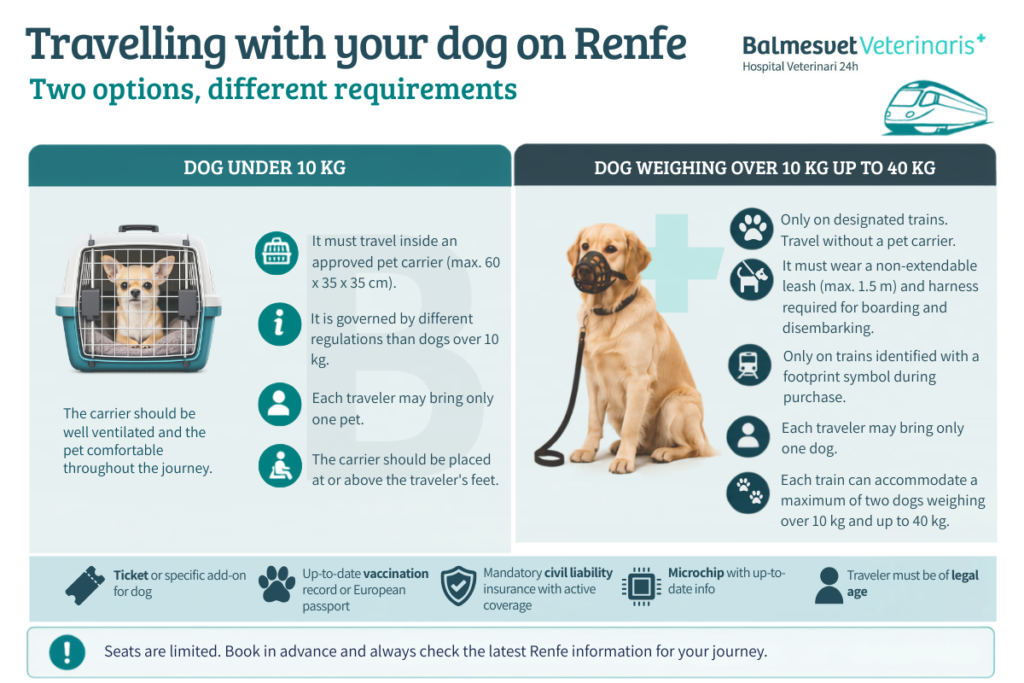
- Dogs weighing between 10 kg and 40 kg can ride without a carrier on trains designated specifically for this service.
- Not all trains allow this option. When you’re purchasing your ticket, check that the route is marked with the paw print symbol.
- Each passenger can travel with only one dog, and one carriage per train will accommodate a maximum of two dogs weighing up to 40 kg.
- The dog must have a microchip, an up-to-date vaccination record or European pet passport, mandatory liability insurance, and a specific ticket or add-on.
- During boarding and disembarking, the dog must be on a non-extendable leash no longer than 1.5 meters and wear a muzzle.
- Getting your dog accustomed to the new environment and the muzzle can help reduce stress and make the experience much more pleasant.
Travelling with Your Dog on Renfe: An Increasingly Accessible Option
More and more people want to travel with their dogs. Whether it’s for a vacation, a weekend getaway, a family visit, or a move, the train can be a comfortable alternative to driving or flying.
Until recently, this option was very limited for medium and large dogs, since most services only allowed small pets to travel inside a carrier.
With the change in regulations, Renfe now makes it easier to travel with dogs on more trains and routes. However, access is still subject to a series of requirements designed to ensure safety, harmony among passengers, and the animal’s well-being.
Knowing the terms and conditions before buying your ticket helps you avoid unexpected problems and plan your trip with greater peace of mind. With good planning, traveling with your dog by train can be a comfortable and safe option for both of you.
So what’s changing with Renfe’s new regulations?
The main change is that dogs weighing between 10 kg and 40 kg can travel without a carrier on eligible services.
Until now, this option was limited to certain AVE trains and some rail routes. Starting in July 2026, Renfe expanded the service to include AVE, Avlo, Alvia, Euromed, Intercity, Avant, and Media Distancia, a change that makes it easier for many families to travel with medium or large dogs.
However, this doesn’t mean that every train automatically allows any dogs weighing up to 40 kg. The service is subject to availability and must be specifically selected during the booking process.
Before booking: Make sure the train you’ve chosen is marked with a paw print symbol. If this option isn’t available, you won’t be able to add the dog add-on later.
Which Renfe trains now allow larger dogs?
Renfe includes this service on:
- AVE
- Avlo
- Alvia
- Euromed
- Intercity
- Avant
- Media Distancia
The expansion applies to both commercial and public services, but available seats remain limited. In addition, certain routes or specific trains may not offer the option.
That’s why, especially during vacations, long weekends, or simply weekends, it’s advisable to make your reservation well in advance.
If you’re travelling internationally, check the specific terms and conditions of AVE Internacional before booking, as they may be subject to regulations that differ from those applicable to domestic trips.
Do all trains in these service categories allow dogs?
No. This is something that can cause a lot of confusion. Although Renfe has expanded the service to its main train types, it can only be booked on trains marked with a paw print symbol.
Before you purchase your ticket, check to make sure that your chosen route allows dogs weighing between 10 kg and 40 kg. This information is available on Renfe’s website and in the official Renfe app during the purchase process.
The service isn’t available on:
- Trains with transfers.
- Trains with scheduled alternative transportation options.
- Co-branded seats—that is, seats on commercial trains that are occasionally sold as Avant or Media Distancia services.
- Combined train and bus tickets.
If the route includes a transfer or a bus journey, you should carefully check the conditions for each stage of the trip.
How many dogs can travel per train?
Renfe has established the following restrictions:
- One dog weighing between 10 and 40 kg per passenger.
- A maximum of two dogs of this size per train.
- Both dogs will travel in a single carriage designated as pet-friendly.
On AVE, Avlo, and long-distance trains, the designated carriage is identified during the purchase process.
Due to the limited number of available seats, it’s best to book as early as possible, especially if you plan to travel during the busy seasons.
How do you buy a ticket for your dog?
The dog must always travel with its own pet add-on or ticket.
You’ll purchase it through:
- The Renfe website.
- The official app.
- In-person travel agencies.
- Online travel agencies.
The add-on must be purchased along with the passenger’s ticket and is available up to 24 hours before departure, provided that seats are still available.
Seats are assigned automatically, so it’s not possible to choose your seat.
The ticket associated with the service:
- Does not allow any changes.
- May be canceled in accordance with the terms of the purchased fare.
On AVE, Alvia, Euromed, and Intercity trains, the service is included in the Choose Standard fare. On Avlo, you’ll need to purchase a ticket at the standard fare and add the corresponding pet upgrade.
How much does the pet add-on cost?
The price depends on the train.
AVE, Avlo, Alvia, Euromed & Intercity
The add-on for travelling with a dog weighing between 10 kg and 40 kg costs 40 euros per direction.
Avant & Media Distancia
For these routes, the service fee is equal to the price of a standard-fare ticket for the selected route. Therefore, the amount may vary depending on the route.
The fee is added to the guardian’s ticket.
Where does the dog sit?
The transportation method depends on the service you’ve chosen.
AVE, Avlo, Alvia, Euromed & Intercity
The system automatically assigns two seats next to each other:
- The person sits in the aisle seat.
- The dog gets the window seat.
During the train ride, the dog can stay:
- In the window seat, which is covered with the seat cover provided by Renfe.
- On the floor, on the mat placed in the window seat foot area.
You cannot choose your own seats because they are preassigned within the designated carriage.
Avant
On Avant trains, dogs must travel on the floor and may not sit in a seat.
Renfe provides a travel kit consisting of a seat cover and a mat. The mat must be placed on the floor of the passenger compartment next to the window.
Medium Distance
In the Medium Distance service, the dog must also remain on the floor and isn’t allowed on the seat.
Unlike other services, the customer must bring their own protective covering or mat.
Overview of Regulations by Train Service
| Train | Dogs weighing 10 to 40 kg without a carrier | Can they sit in the seat? | Service Price |
| AVE | Yes | Yes | 40 € |
| Avlo | Yes | Yes | 40 € |
| Alvia | Yes | Yes | 40 € |
| Euromed | Yes | Yes | 40 € |
| Intercity | Yes | Yes | 40 € |
| Avant | Yes | No | Standard fare |
| Media Distancia | Yes | No | Standard fare |
Can my dog roam freely during the train ride?
No. During the trip, the dog must remain in its assigned spot until you reach your destination. It must be secured with a leash to the seat or the front footrest and may not move freely around the train.
The owner must not leave the dog unattended. If the owner needs to use the restroom, the dog must be properly secured to the footrest or the seat inside the carriage, following Renfe’s instructions. In exceptional circumstances, the owner may take the dog with them to the restroom.
Therefore, it is important that your dog has been walked and has relieved itself before boarding the train.
What documentation do you need to travel with your dog on Renfe?
Before starting your trip, make sure all your documents are up to date.
Renfe requires:
- An up-to-date vaccination record, signed and stamped by a veterinarian, or a European pet passport.
- Microchip identification with up-to-date information.
- A ticket or specific add-on for the dog.
- The person travelling with the pet must be of legal age.
- Mandatory civil liability insurance policy.
Although rabies vaccinations are not generally required in Catalonia, if you plan to travel to another autonomous community, you should check the regulations at your destination, since they are required in most of them. Therefore, it’s advisable to keep your pet’s rabies vaccination up to date if you plan to travel outside Catalonia. If you’re also travelling abroad, it will be a mandatory requirement along with the European pet passport.
Remember that, according to current regulations, dogs must have liability insurance covering third-party damage. Before travelling, check that the coverage is in effect. Some pet health insurance plans include this coverage or allow you to add it as an optional extra. In other cases, this coverage may be part of your home insurance policy. If you have any questions, check with your insurance provider to confirm that your dog is covered and make sure to review the policy terms.
Microchips: Much More Than a Legal Requirement
If your dog gets lost at a station, during a stop, or when getting off the train, the microchip allows it to be identified and for us to contact you.
Before travelling, we recommend checking that:
- The microchip can be scanned correctly.
- Your contact information is up to date.
- The associated phone number is still correct.
- The registered address has not changed.
Many people change their address or phone number and forget to update this information. If a dog goes missing, outdated information can make it much harder to track it down.
You might be interested in: The importance of microchips for dogs and cats.
Is a muzzle mandatory inside the train?
Yes, although the dog does not have to wear it for the entire trip.
The dog must wear:
- A muzzle at the station.
- A muzzle during boarding.
- A muzzle during disembarking.
- A non-extendable leash no longer than 1.5 meters during all phases of the trip.
Once the train has closed its doors and begun moving, the muzzle may be removed. During the trip, it need only be kept on if the owner deems it appropriate. The dog must remain on a leash and stay in the designated area.
At Balmesvet, we recommend getting your pet used to wearing a muzzle well in advance using positive reinforcement. Putting it on for the first time on the day of the trip can cause resistance, fear, or increase your pet’s stress levels.
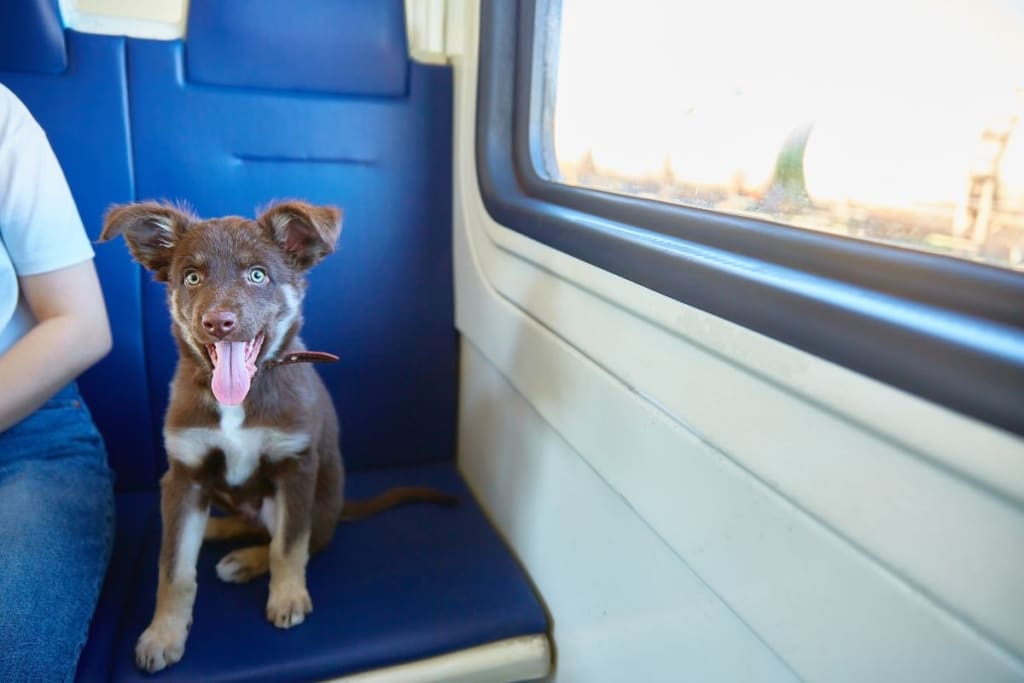
Which dogs are NOT allowed?
Renfe excludes the following from this service:
- Dogs under one year of age.
- Dogs of breeds classified as potentially dangerous (PPP).
- Dogs weighing less than 10 kg (they must travel in a carrier).
- Female dogs in heat.
These exclusions apply separately. For example, a dog under one year of age may not use the service even if it does not belong to a potentially dangerous breed.
Guide dogs and service dogs are subject to different conditions: they travel free of charge and are not subject to these weight or transportation restrictions.
Travel essentials for taking your dog on Renfe trains
The caregiver should always carry a hygiene kit containing, at a bare minimum:
- A pee pad.
- Poo bags.
- Wipes.
- Disinfectant and deodorizing spray.
The person responsible for the dog must immediately clean up any mess that occurs.
In addition, Renfe provides a travel kit that includes a seat cover and a mat on:
- AVE.
- Avlo.
- Alvia.
- Euromed.
- Intercity.
- Avant.
On Media Distancia, travelers must bring their own travel kit or protective materials.
Why is it important to plan your train trip in advance?
Following the rules is only a small part of your preparation.
Just as important as having your ticket or bringing the necessary documentation is making sure your dog can handle an experience that may be completely new to them.
A crowded station, the loudspeaker system, rolling suitcases, automatic doors, platforms, the train’s movements, or being around strangers can cause anxiety.
While some dogs adapt quickly, others may show signs of fear or stress as soon as they enter the station.
Preparing your dog for the experience in the days or weeks leading up to the trip will help make the journey more manageable. At Balmesvet, we recommend a gradual acclimatization process based on positive reinforcement and always respecting the dog’s individual pace.
This approach is part of the Fear Free philosophy, a model of veterinary care aimed at reducing patients’ fear, anxiety, and stress. Although it’s usually associated with veterinary appointments, its principles can also be applied to everyday situations such as a train trip, a stay at a boarding facility, or any major change in your dog’s routine.
If you’d like to learn how we apply our techniques to improve the emotional well-being of cats and dogs during veterinary care, you can read our article on the Fear Free philosophy and stress-free veterinary care.
The goal is not just for you to be able to board the train, but for you to travel as comfortably as possible.
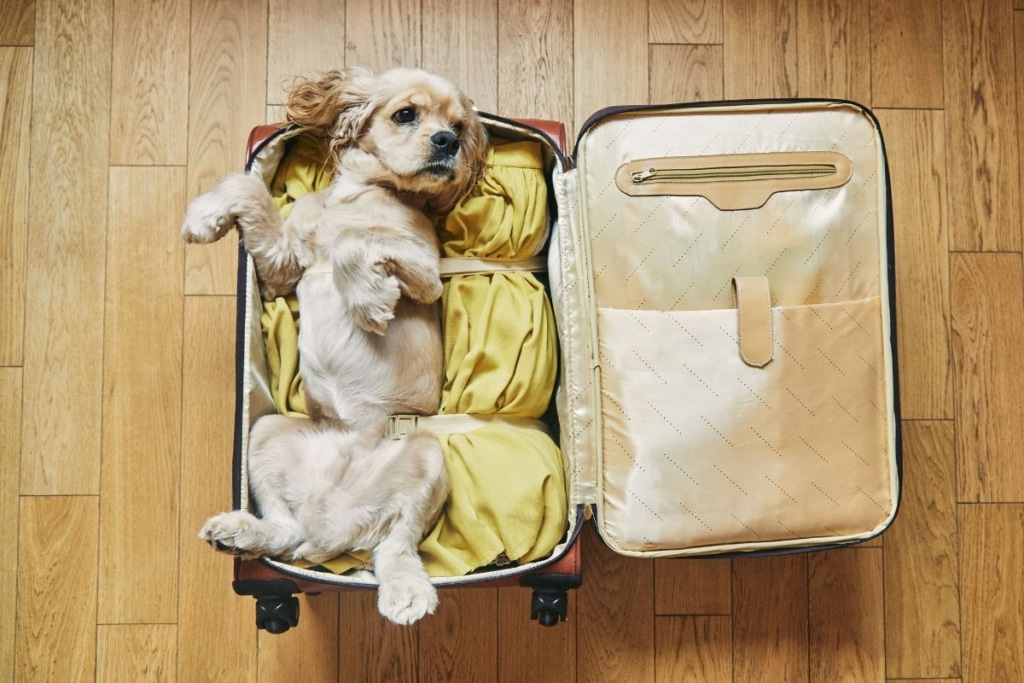
How to Prepare Your Dog for a Trip by Train
Gradually accustom them to new stimuli
If your dog has never traveled by train, avoid making their first experience a long trip.
You can start by taking them to areas near a station, as long as the surroundings are safe and your dog can stay at a distance where they feel comfortable.
Let them observe their surroundings without forcing them to get closer. Use treats, soothing words, and positive experiences so they associate the environment with something pleasant.
The more familiar your dog becomes with travelling by train, the less likely they are to experience fear or anxiety during the trip.
Get them used to the muzzle before the trip
The muzzle should be introduced gradually.
Start by letting your dog sniff it and rewarding any attempts to approach it on its own. Later, you can place small treats inside so your dog will put its snout in without fastening the straps.
Gradually increase the amount of time your dog wears it, and never use it for the first time in a situation that’s already stressful for your dog.
Walk your dog before getting on the train
A leisurely walk will allow them to:
- Do their business.
- Burn off some energy.
- Arrive at the station feeling more relaxed.
- Feel less of a need to move around during the trip.
Avoid playing too hard right before boarding the train, since it could rile them up.
Avoid escalators
This is one of the most important recommendations before boarding the train.
Renfe recommends using elevators or staircases instead of escalators and moving walkways.
Although they may seem safe, escalators pose one of the greatest risks of accidents for dogs. Some dogs may feel insecure or become frightened by the movement; furthermore, their paws, nails, or fur can get caught between the steps or in the escalator’s moving parts, causing injuries that can be easily avoided by using the elevator or conventional stairs.
These types of accidents can cause serious injuries, such as pulled nails, deep wounds, fractures, or injuries from being crushed. In some cases, they require urgent veterinary care and even surgical treatment.
Whenever possible, use the elevator or the regular stairs to get to the platform. It’s a simple step that can help prevent a serious emergency.
Bring familiar items that make them feel safe
An unfamiliar environment with new sounds, smells, and people can be stressful for some dogs. Bringing items that are already part of their daily routine can help them feel more secure during the trip.
A blanket, towel, or mat that smells like home can provide a sense of familiarity and help them relax in their assigned space.
If your dog is used to it, you can also bring a quiet toy like a Kong, lick mat, or another refillable toy filled with a small amount of wet food, dog-specific pâté, or a treat they find appealing. Licking and chewing can help some dogs stay entertained and reduce their stress levels throughout part of the trip.
Nevertheless, avoid giving your dog toys that are too playful, make noise, or can roll across the floor and disturb other passengers. Likewise, if your dog tends to guard its food or toys when people are nearby, it’s best not to use them during the trip in order to avoid uncomfortable situations.
The goal isn’t to keep your dog constantly occupied, but to provide them with resources that help them handle the train ride in a way that’s more relaxed and safe.
Should they eat before travelling?
Avoid feeding your dog a large meal right before travelling. A very full stomach can increase the risk of nausea, vomiting, and discomfort during the train ride.
For many healthy adult dogs, it may be best to feed them earlier than usual or reduce the portion size in the hours leading up to the trip. That said, extended fasting isn’t always recommended. Some pets handle the trip better after eating a small amount of food, especially if the journey is long or if they need to take medication.
This should be decided on a case-by-case basis for each dog. For puppies, diabetic dogs, dogs with digestive disorders, or those who need to take medication with food, fasting may not be appropriate. In these cases, consult your veterinarian beforehand to determine the most suitable schedule and portion size.
Keep water available, and during the trip offer small amounts if your dog does not show signs of nausea or vomiting. The WSAVA’s travel guidelines also emphasize adapting access to water, food, and opportunities to relieve themselves to each animal’s individual needs.
Internal and External Deworming
Before travelling, it’s also a good idea to check that your dog’s flea and tick prevention is up to date for the destination, the time of year, and the planned activities. Spending a few days in a city is not the same as travelling to a rural, mountainous, or coastal area, where exposure to fleas, ticks, mosquitoes, or sand flies may be higher.
Before setting off, make sure your dog’s flea and tick protection is still effective and that your dog has been properly treated for worms in accordance with your veterinarian’s recommendations. This simple check can help prevent parasite-borne diseases and avoid problems during your vacation.
Check your dog’s health before the trip
It’s not recommended to travel if your dog is experiencing:
- Vomiting.
- Diarrhea.
- Fever.
- Pain.
- Difficulty breathing.
- Weakness.
- Any significant change in behavior.
Renfe recommends having your dog checked by a veterinarian beforehand, especially before a long trip or if you have any concerns about their health.
What should I do if my dog gets motion sickness on the trip?
Some dogs may experience motion sickness (kinetosis), nausea, anxiety, or a combination of these symptoms when travelling by train.
The most common signs are:
- Heavy panting.
- Abnormal salivation.
- Repeated yawning.
- Restlessness.
- Trembling.
- Nausea.
- Vomiting.
- Whimpering or other vocalizations.
- Inability to lie down or relax.
- Constant attempts to find a comfortable position.
If these symptoms appear:
- Stay calm.
- Speak to them in a calm voice.
- Avoid forcing physical contact.
- Minimize stimuli as much as possible.
- Let them stay on their blanket or mat.
- Offer them a small amount of water if they can stomach it and aren’t vomiting.
Currently, there are specific veterinary medications that can help prevent motion sickness and improve your travel companion’s well-being during the trip. However, they must be prescribed by a veterinarian, since not all dogs need the same treatment and some medications must be administered several hours before the trip to be effective.
Not all dogs enjoy travelling by rail
It’s easy to assume that if we enjoy a trip, our dog will too. However, everyone experiences these situations differently.
Some remain relaxed throughout the entire trip, while others show signs of discomfort as soon as they arrive at the station.
Among the most common signs of stress are:
- Constant panting even when it’s not hot.
- Excessive salivation.
- Shaking.
- Tail tucked between the legs.
- Ears pinned back.
- Fixed or very wide-eyed stare.
- Attempts to run away.
- Refusal to walk.
- Vocalizations.
- Not moving.
- Refusal of food or treats.
If your dog exhibits these behaviors to an extreme degree, you should consider whether they are ready to travel or if they need time to adjust beforehand.
The goal shouldn’t be just to get through the trip. Their emotional well-being is also part of their overall health.
How about giving them a sedative before travelling?
Do not administer medication without consulting a veterinarian first.
Some sedatives may cause:
- Excessive drowsiness.
- Disorientation.
- Changes in blood pressure.
- Difficulty maintaining balance.
- Problems regulating body temperature.
- Unexpected or adverse reactions.
In addition, just because a dog sits still doesn’t necessarily mean it’s no longer afraid. Some medications reduce a dog’s ability to react without actually reducing their anxiety.
There are different strategies to help dogs that have trouble travelling:
- Habituation and behavior modification programs.
- Pheromones.
- Certain nutraceuticals.
- Specific veterinary medication when indicated.
- Schedule and travel time adjustments.
The right choice will depend on each pet’s age, health, level of fear, and previous experiences.
At Balmesvet, we work according to the Fear Free principles, which are designed to reduce fear, anxiety, and stress. This philosophy can also be applied when preparing for travel with each pet on an individualized basis.

Common Mistakes When travelling by Train with a Dog
Waiting until the last minute to buy a ticket
Each train allows a maximum of two dogs weighing between 10 kg and 40 kg, and the pet add-on can only be purchased up to 24 hours before departure.
During holidays, weekends, or long weekends, seats can sell out quickly.
Not checking for the paw-print symbol
Whether the train is an AVE, Avlo, Alvia, Euromed, Intercity, Avant, or Media Distancia does not in itself guarantee that seats will be available for that specific trip.
Always make sure the icon appears when you’re purchasing your ticket.
Using the muzzle for the first time on the day of the trip
A muzzle shouldn’t be worn for the first time right before heading to the station.
Get your dog used to it over the preceding days or weeks using treats and short training sessions.
Not checking documents
An outdated registration card, a lack of insurance, or a microchip with outdated information may prevent you from boarding the train or complicate the handling of an incident.
Forgetting their hygiene kit
Renfe requires that the guardian bring a pee pad, bags, wipes, and disinfectant and deodorizing spray.
The seat cover and mat provided by the company do not replace these items.
Thinking your dog can walk around on the train
During the train ride, the dog must remain in its designated space at all times. A good walk before boarding is crucial.
Assuming that all dogs enjoy travelling
While some find it easy to adapt, others may experience fear, anxiety, or dizziness.
Observing their body language helps you assess whether they’re truly ready.
Administering medication without consulting a veterinarian
Not all tranquilizers are suitable for travel, and some may make the experience worse or cause side effects.
FAQ About travelling with Dogs on Renfe
Can dogs under 10 kg travel without a carrier?
No. On most Renfe services (AVE, Avlo, Larga Distancia, Avant, and Media Distancia), pets must travel for the entire journey inside an approved carrier measuring no more than 60 × 35 × 35 cm, placed at the passenger’s feet or on their lap.
The exception is on Cercanías and Media Distancia de Ancho Métrico services, where dogs may travel without a carrier, provided they are on a leash and wearing a muzzle.
Can a large dog travel on Renfe?
Yes. Starting in July 2026, Renfe allows passengers to travel with dogs weighing more than 10 kg and up to 40 kg on certain designated trains. You must book the specific add-on and meet the requirements set by the company.
Do all Renfe trains allow dogs weighing between 10 kg and 40 kg?
Renfe allows passengers to travel with dogs weighing between 10 kg and 40 kg on its main long- and medium-distance services. However, before purchasing your ticket, you should check whether this option is available for the specific trip. On the Renfe website or app, you’ll see an icon indicating this option and the option to add the corresponding additional fare.
Dogs under 10 kg are subject to different conditions and, as a general rule, must travel inside an approved carrier.
Can I take two dogs?
Each passenger may bring only one dog weighing between 10 kg and 40 kg.
A total of two dogs of this size may travel in each train, provided they are in the designated carriage.
Is a microchip mandatory?
Yes. The dog must be properly registered and the information associated with the microchip must be up to date.
Is liability insurance obligatory?
Yes. Renfe requires that you have mandatory civil liability insurance for your dog.
Does my dog have to wear a muzzle the entire time?
No. They must wear it at the station and during boarding and disembarking. Once the train starts moving, you can take it off, but the dog must remain on a non-extendable leash no longer than 1.5 meters.
Can my dog ride in the seat like any other passenger?
On AVE, Avlo, Alvia, Euromed, and Intercity trains, they can sit in the inside seat next to the window using the protective seat cover provided by Renfe.
On Avant and Media Distancia trains, they must travel on the floor.
Can they walk around the train?
No. They have to stay in their assigned seat until they reach their destination.
When should I purchase the pet add-on?
It can be purchased up to 24 hours before departure, provided there are still seats available.
Can I change my dog’s train ticket?
The tickets purchased for this service cannot be changed. Cancellations are subject to the terms and conditions of the fare purchased.
Can puppies travel on Renfe?
Yes, but it depends on the travel conditions.
Under the conditions for pets weighing up to 10 kg, a puppy may travel as long as it meets the requirements set by Renfe, such as travelling in an approved carrier.
However, under the conditions for dogs weighing more than 10 kg and up to 40 kg, Renfe does not allow dogs under one year of age.
Can a dog in heat travel by train?
No. Females in heat are excluded from this service.
What if my dog gets nervous during the trip?
Stay calm, avoid forcing contact, and let them remain on their blanket or mat.
If they show frequent or intense signs of fear, consult a veterinarian before taking them on another trip.
Can dogs ride on commuter (cercanías) trains?
Yes, but different conditions apply.
On commuter trains, pets are allowed with no weight limit. They travel for free, do not need a ticket, and do not have to be in a carrier. Dogs must be kept on a leash and wear a muzzle. One pet per person is allowed.
Can a dog with anxiety or a fear of trains travel by train?
It depends on each individual case. Some dogs may gradually adapt through a process of habituation, while others may need more specific training or even veterinary treatment. If your dog shows severe signs of fear or anxiety during travel, consult your veterinarian before planning the trip.
Can they drink water during the trip?
Yes. It’s a good idea to offer small amounts of water during the trip, especially on long trips or during hot weather. A portable water bowl can help ensure that your dog stays properly hydrated.
What if my dog barks?
An occasional bark is usually not a problem. However, if the dog is very anxious, barks continuously, or disrupts the travel experience, Renfe staff may intervene to assess the situation. Preparing your dog in advance and recognizing the early signs of stress will help prevent these types of situations.
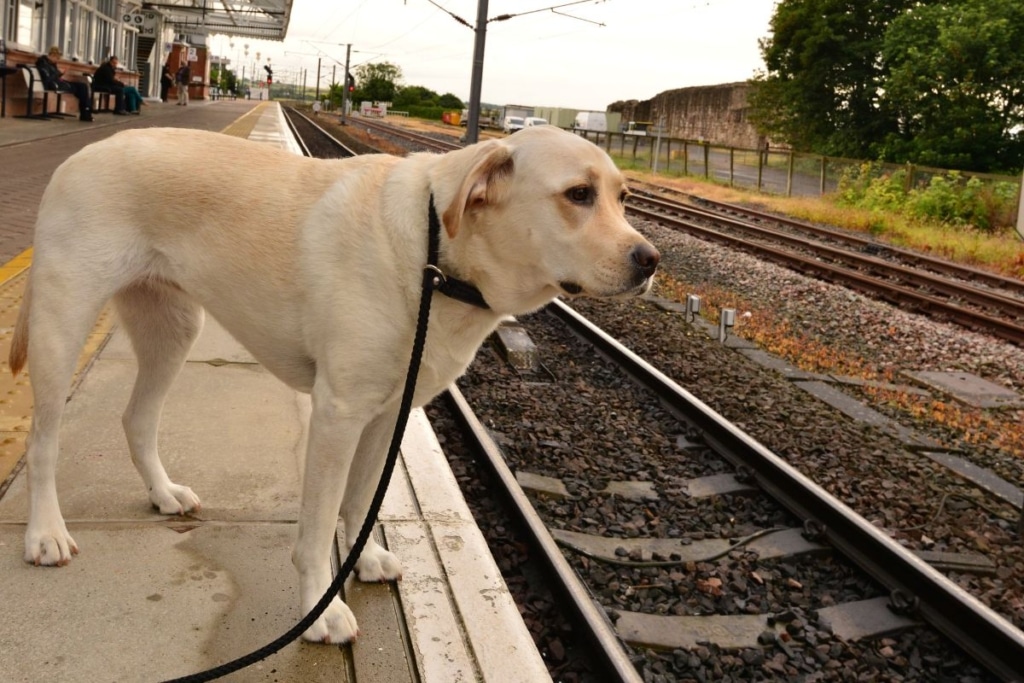
Is it worth it to travel with your dog on Renfe?
For many dogs and their owners, the train can be a convenient alternative for travelling without having to use a car. However, not all dogs experience the journey the same way.
If your dog is used to travelling, handles new environments well, and you’ve planned the trip in advance, travelling by train can be a very convenient option. On the other hand, if your dog experiences intense fear, anxiety, or motion sickness when they travel, it’s a good idea to consult with a veterinarian beforehand to determine whether this type of transportation is appropriate or if your dog needs time to adjust.
If you’re planning a vacation with your pet, we recommend checking out our guide Vacation with Pets: Travel with Your Dog or Cat Stress-Free, where you’ll find tips for planning your trip, packing, and making the journey as comfortable and safe as possible.
Beyond simply complying with regulations, the goal should be to ensure the trip is as safe and comfortable as possible, both for the dog and for the other travelers.
Every dog experiences travelling differently. Preparing your dog ahead of time can make the difference between a comfortable trip and a stressful one.
Travelling with your dog also means taking care of their well-being
The expansion of Renfe’s regulations is a major step forward for families with medium- or large-sized dogs. Thanks to this new policy, many pet owners will be able to travel with their dogs more easily.
However, preparing for a trip isn’t just about buying a ticket or gathering the necessary paperwork. It also involves considering how the dog itself will experience the journey.
A trip can be a calm experience for some pets and very stressful for others. Respecting their needs, gradually acclimating them to new environments, and planning each step will help make the experience safer and more enjoyable.
If you have concerns about your dog’s health before travelling, if your dog tends to get motion sickness, or if they are afraid of travelling, at Balmesvet Hospital Veterinari in Barcelona, we can perform a pre-trip checkup and assess the most appropriate measures for your dog’s specific situation.
You’ll find us at Balmes 205, Barcelona. You can schedule an appointment by calling 931 173 173 or emailing atencioclient@balmesvet.com.
 Barcelona, C/ Balmes nº 205
 931 173 173
 info@balmesvet.com